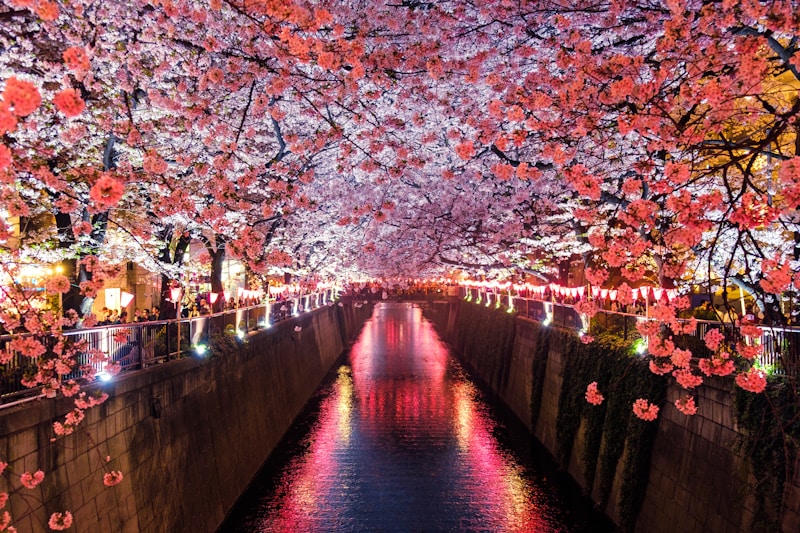
Japan’s Most Anticipated Season
Every year, an event unlike any other sweeps across Japan from south to north: sakura season (cherry blossom season). For roughly two weeks, the country transforms into a living painting — pink and white blossoms cascade over parks, rivers, castle moats, and mountain paths.
The Japanese have celebrated hanami (flower viewing) for over a thousand years. Today it draws millions of domestic and international visitors and represents one of the most breathtaking natural spectacles on earth.
This guide covers everything you need to plan your visit.
When Do Cherry Blossoms Bloom?
Sakura season is dictated by temperature and varies significantly by location and year. Here is the general timeline:
| Region | Peak Bloom Period |
|---|---|
| Okinawa | Late January – February |
| Tokyo & Osaka | Late March – Early April |
| Kyoto | Late March – Early April |
| Sendai | Mid – Late April |
| Sapporo (Hokkaido) | Late April – Early May |
| Hirosaki (Aomori) | Late April – Early May |
Peak bloom (満開 / mankai) typically lasts only 5–10 days before the petals fall. However, the “petals falling” stage — called hanafubuki (flower blizzard) — is arguably even more beautiful. The entire season from first bloom to full petal fall lasts about two weeks.
How to Track Bloom Predictions
The Japan Meteorological Corporation releases official sakura forecast updates starting in January each year. Reputable tracking sites include:
- Japan National Tourism Organization (jnto.go.jp)
- Weather News (weathernews.jp/sakura)
These sites show bloom timing down to the city level and update weekly as the season approaches.
The Best Cherry Blossom Spots in Japan
Tokyo
Ueno Park (上野公園) — Japan’s most famous hanami spot. Over 1,200 trees, food stalls everywhere, and a festival atmosphere. Gets extremely crowded but unmissable.
Shinjuku Gyoen (新宿御苑) — A former Imperial garden with 1,100 trees of 65 varieties, including early and late-blooming species that extend the season. Entry fee (¥500) keeps it calmer than free parks.
Meguro River (目黒川) — A 4km riverside walk lined with 800 weeping cherry trees. At night, lanterns illuminate the blossoms for a magical experience. Best on weekday evenings.
Chidorigafuchi (千鳥ヶ淵) — A castle moat turned sakura corridor. Rent a rowboat (¥800/30 min) and float beneath overhanging blossoms — one of Japan’s most romantic experiences.
Kyoto
Maruyama Park (円山公園) — Home to Kyoto’s most photographed tree: a massive weeping shidarezakura that’s lit up at night. Iconic.
Philosopher’s Path (哲学の道) — A 2km canal-side path lined with hundreds of Somei Yoshino cherry trees. Named after philosopher Nishida Kitaro, who walked it daily. Serene and beautiful.
Kiyomizudera (清水寺) — The wooden stage of this hillside temple with cherry blossoms in the foreground is a classic Japan photograph. Visit at dusk for golden-hour magic.
Outside the Big Cities
Hirosaki Castle (弘前城), Aomori — Perhaps Japan’s single greatest sakura spectacle. The moat turns entirely pink from fallen petals. About 2,600 trees of 52 varieties. Worth the journey north.
Mount Yoshino (吉野山), Nara — A mountain covered in 30,000 cherry trees, blooming in waves from base to summit over several weeks. One of Japan’s three great sakura spots.
Takato Castle (高遠城), Nagano — Known as “the best in Japan” by many locals for its dense concentration of Takato Kohigan cherry trees, a rare variety with deep pink blooms.
Hanami: How to Celebrate Like the Japanese
Hanami (花見) literally means “flower viewing,” but in practice it’s a picnic party held under the blossoms. Here’s how it works:
Claim your spot early. In popular parks, groups send a member ahead — sometimes hours in advance — to lay a tarp and reserve space. On weekends, the best spots can fill by 8 AM.
Bring the right food. Traditional hanami foods include onigiri, tamagoyaki (rolled egg), yakitori, and sakura-flavored sweets. Most convenience stores sell special hanami packs in season.
Bring drinks. Canned beer and chuhai are standard. Many parks have food and drink vendors during peak season.
Don’t forget a tarp/sheet. Blue plastic tarps are iconic in Japanese parks — bring a waterproof picnic blanket.
Respect the trees. Don’t pick branches or climb trees. The blossoms are for everyone to enjoy.
Planning Tips for International Visitors
Book Accommodation 3+ Months in Advance
Cherry blossom season is Japan’s busiest tourism period. Popular hotels in Tokyo and Kyoto can sell out entirely 4–6 months in advance. If you don’t have accommodation locked in, start immediately.
Consider Shoulder Timing
Visiting just before peak bloom (60–80% bloom) means lighter crowds and similar beauty — the trees still look spectacular. Alternatively, after peak bloom, the fallen petal stage (petal snow) is uniquely beautiful and crowds drop dramatically.
Embrace the Rain
A rainy day during sakura season creates a completely different kind of beauty — petals on wet stone, puddle reflections of pink branches, the quiet that settles over a garden in drizzle. Locals often say the best hanami moments happen in the rain.
Affiliate Picks: Plan Your Sakura Trip
- ✈️ Japan Rail Pass — Essential for exploring multiple cities during sakura season. Check prices on Klook (affiliate link)
- 🏨 Japan Hotel Search on Booking.com — Book early for cherry blossom season! Search now (affiliate link)
- 📸 Cherry Blossom Photography Guide — Best settings and tips for sakura photos. View on Amazon (affiliate link)
- 🌸 Sakura Cosmetics Gift Set — Cherry blossom season’s most popular souvenirs. View on Amazon (affiliate link)
Final Thoughts
Cherry blossom season is not just beautiful — it’s meaningful. The transience of sakura blooms (two weeks and then gone) speaks to the Japanese concept of mono no aware (the pathos of things) — a bittersweet appreciation of beauty precisely because it fades.
Sitting under a cherry tree, watching petals drift down like snow, surrounded by music and laughter and good food — this is Japan at its most alive.
No photograph will fully capture it. You have to be there.